Rebel Sell by Joseph Heath
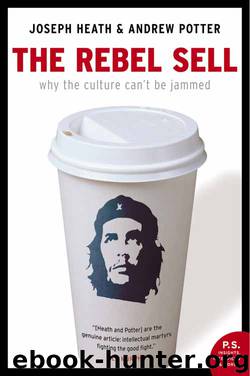
Author:Joseph Heath [Joseph Heath & Andrew Potter]
Language: eng
Format: epub
ISBN: 9781554689187
Publisher: HarperCollins Canada
][
Under the old bourgeois Protestant pecking order, how you ranked was to a considerable extent determined by what you did (or, for women, by what your husband did). Back in the ’50s, Packard identified six factors that combined to establish the prestige of a given occupation: the importance of the task performed, the authority inherent in the job, the knowledge and brains required, the dignity of the tasks performed, and the financial rewards. He then cited a number of surveys conducted during the ’50s that tried to arrive at an overall ranking of jobs according to prestige.
The results were remarkably consistent. In almost all cases, Supreme Court justices were seen as having the most prestigious job in America, followed immediately by physicians. Other highprestige professions included banker, business executive, minister and college professor. Down toward the bottom of the list we find accountants, advertising executives, journalists and labor union officials.
Here we can see a very clear expression of the status hierarchy that we all intuitively identify with the mass society of America in the ’50s. The “prestige professions” are very much pillars of the establishment, serving at high levels in the most dominant institutions in society. They are also extremely paternalistic professions. Judge, minister, banker, doctor, professor—these are all distinguished by the fact that they place the job holder on the expertise and authority side of a fiduciary relationship. Thus members of these professional groups not only had a great deal of prestige, they also had a great deal of power and influence. They were the dominant figures of a ruling elite that sustained itself through family, school and institutional ties. In this respect, these people were members of a secularized aristocracy, the social elite in whose hands the fate of society rested.
Today, members of this group may still rate high on some traditional measures, but the influence associated with that rank is steadily waning. Prestige is not what it used to be; power is increasingly wielded not by the bourgeois, paternalistic aristocrats but by the cool, bohemian creative types. Over the past decade and a half, this creative class has transformed the cultural and economic landscape. It is not hard to see how this transformation could occur. In a modern capitalist economy, knowledge and education have become far more important than lineage and social connections. The market demands enormous geographic mobility—members of the dominant class now routinely hold down jobs in two or three cities simultaneously. And, finally, wealth has become far less important than income when it comes to sustaining the lifestyles and consumption habits of the social elite. The ultra-rich in America—from movie stars to corporate CEOs—earn their money from salaries, not from investments.
In other words, the staid and sedentary bourgeois elite, whose habits and style of life were essentially modeled on the old English aristocracy, was slated for destruction very early on by the forces of capitalism itself. The restless, individualistic, free-spirited bohemian is, in many ways, much more in tune with the true spirit of
Download
This site does not store any files on its server. We only index and link to content provided by other sites. Please contact the content providers to delete copyright contents if any and email us, we'll remove relevant links or contents immediately.
Influence: The Psychology of Persuasion by Robert B. Cialdini(4757)
The Miracle Morning by Hal Elrod(4698)
The Hacking of the American Mind by Robert H. Lustig(4361)
Pre-Suasion: A Revolutionary Way to Influence and Persuade by Robert Cialdini(4205)
Unlabel: Selling You Without Selling Out by Marc Ecko(3642)
Ogilvy on Advertising by David Ogilvy(3588)
Hidden Persuasion: 33 psychological influence techniques in advertising by Marc Andrews & Matthijs van Leeuwen & Rick van Baaren(3540)
Purple Cow by Seth Godin(3186)
Who Can You Trust? by Rachel Botsman(3118)
Kick Ass in College: Highest Rated "How to Study in College" Book | 77 Ninja Study Skills Tips and Career Strategies | Motivational for College Students: A Guerrilla Guide to College Success by Fox Gunnar(3108)
The Marketing Plan Handbook: Develop Big-Picture Marketing Plans for Pennies on the Dollar by Robert W. Bly(3034)
This Is Marketing by Seth Godin(3010)
I Live in the Future & Here's How It Works by Nick Bilton(2977)
The Power of Broke by Daymond John(2957)
The Tipping Point by Malcolm Gladwell(2900)
Building a StoryBrand by Donald Miller(2883)
The 46 Rules of Genius: An Innovator's Guide to Creativity (Voices That Matter) by Marty Neumeier(2832)
Draw to Win: A Crash Course on How to Lead, Sell, and Innovate With Your Visual Mind by Dan Roam(2769)
Market Wizards by Jack D. Schwager(2689)
